 Skip to content



Market Analysis · November 2026
Search for Riviera Maya property news this year and you will mostly find Tulum: the oversupply, the halved sales, the price claims nobody can reconcile. Because Puerto Morelos sits in the same tourism corridor, it tends to get folded into that story by default. The published numbers do not support the comparison. On the three measures that actually explain what went wrong in Tulum — who lives in the housing, how much of it is being built, and whether anyone is enforcing the rules — Puerto Morelos reads as close to the opposite. What follows is the 2026 data, with every figure attributed and every gap marked rather than filled in.
Tulum’s problem was never too many buildings
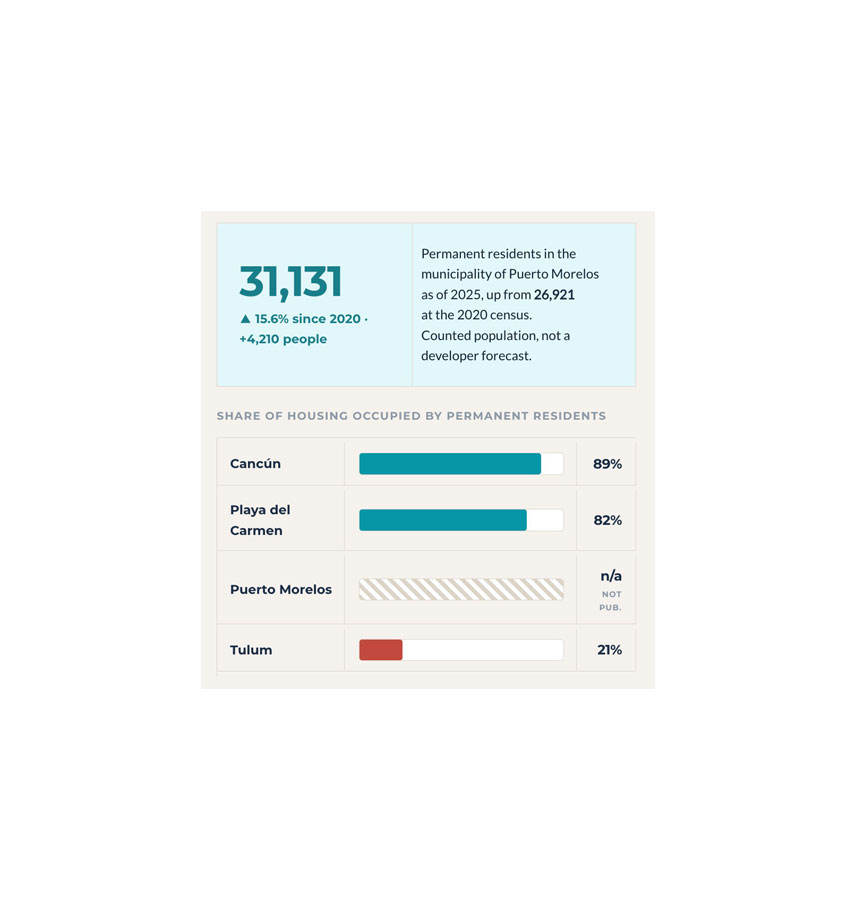
It was too many buildings for people who don’t live there. InfoHabitat, analysing Softec and tourism ministry data, found permanent residents occupy just 21% of Tulum’s housing stock. So when visitor numbers dipped roughly 7% between 2023 and 2025, there was no local demand underneath to absorb the shock — and annual home sales fell about 51%, from 3,487 units to 1,711.
Puerto Morelos has the opposite condition. Its resident base is not a projection; it was counted.
31,131 ▲ 15.6% since 2020 · +4,210 people | Permanent residents in the municipality of Puerto Morelos as of 2025, up from 26,921 at the 2020 census. Counted population, not a developer forecast. |
Share of housing occupied by permanent residents
| Cancún | 89% | |
| Playa del Carmen | 82% | |
| Puerto Morelos | n/aNOT PUB. | |
| Tulum | 21% |
On that empty bar. InfoHabitat did not publish a resident-occupancy rate for Puerto Morelos, so none is shown. An estimate would have been easy to invent and impossible for a reader to check. The census figure above does the same work and can be verified.
The pipeline is roughly a tenth the size of its neighbours
Scale is the second reason Puerto Morelos cannot repeat Tulum’s oversupply: there simply isn’t enough being built. Counting active vertical housing projects in 2026 on a single consistent methodology:
Active vertical housing projects, 2026
| Cancún | 201 | |
| Playa del Carmen | 184 | |
| Puerto Morelos | 17 |
Published project counts disagree because each source counts a different universe of buildings: Reference RE (2026, vertical only) gives Cancún 201, Playa 184, Puerto Morelos 17; Softec (Q1 2026, all new housing) gives Cancún 141, Playa 167, Tulum 240; 4S Real Estate (2025, tourist condominiums) gives Cancún 87, Playa 106, Tulum 223. The chart above uses the only source that covers Puerto Morelos, so all three bars share one methodology — and because that source publishes no matching Tulum figure, Tulum is left out rather than imported from a different count.
What’s actually keeping supply low
Not weak demand — enforcement. The 2026 Programa de Desarrollo Urbano tightened the rules on building near the cenotes and the aquifer, and the municipality has been applying them. On the Ruta de los Cenotes alone, this year:
| ||
| ||
| ||
|
The arithmetic worth noticing. Around 30 developments identified, roughly 10 closed, about 8 regularising. That leaves a remainder in neither category. For anyone buying pre-construction here, permit status — not finish quality, not the renderings — is the first thing that needs verifying.
The honest risks
None of this makes Puerto Morelos a sure thing. Four things complicate the case, and all four are documented:
| Risk | What the record shows | Status |
|---|---|---|
| Water & the PDU | Scientists and residents formally challenged the 2026 PDU as having been approved before the POEL ecological ordinance — inverting the legal order — and petitioned to suspend new development authorisations over aquifer contamination. The same rules protecting supply scarcity are themselves contested. | Unresolved |
| Softening occupancy | Hotel occupancy across Cancún, Puerto Morelos and Isla Mujeres averaged 76.4% from January to May 2026, against 79.2% in the same months of 2025 — even though Puerto Morelos itself opened the year above 90%. | Watch |
| Lodging supply | Roughly 7,900 hotel rooms at the end of 2025, rising to 8,450 rooms plus 653 vacation-rental units by March 2026, with a USD 250 million Finest Puerto Morelos hotel announced. | Watch |
| Market depth | Broker databases track on the order of 1,100–1,200 active units across roughly 21 developments. Thin supply supports pricing, but it also means a slower, less certain resale. | Structural |
What this means if you’re buying in Puerto Morelos
The pattern across all four sections is consistent. Puerto Morelos is small, its population is genuinely growing, and its supply is held down by rules that the municipality has shown it will enforce. That combination is protective of values in a way Tulum’s never was — Tulum’s inventory was built on the assumption that tourist demand was infinite, and Puerto Morelos structurally cannot make that bet at four homes per hectare.
But the same enforcement that protects the market relocates the risk. In an oversupplied market your danger is that values fall. In a tightly permitted one, your danger is specific and personal: that your building is among the ones that didn’t follow the rules. Ten closures out of roughly thirty identified developments is not a background statistic — it is a live probability attached to an individual purchase, and the figures suggest a number of projects are neither shut down nor formally regularising.
Which changes what due diligence means here. In Tulum the critical question for the last three years has been whether the price was real.
In Puerto Morelos the critical question is whether the permits are — federal environmental authorisation first, municipal construction licence second, in that order. That is verifiable before you sign, and it matters considerably more than anything in the brochure.
Sources. Resident occupancy, Tulum construction, inventory and sales figures: InfoHabitat analysis using Softec and Secretaría de Turismo data, reported by El Economista (July 2026) and Expansión / Obras (30 October 2026). Population: Censo / conteo de población via Coespo Quintana Roo, 2025 figures published September 2026; INEGI Censo 2020. Project counts: Reference Real Estate (2026), Softec (Q1 2026), 4S Real Estate Índice de Verticalización (2025). Enforcement figures: municipal Secretaría de Medio Ambiente statements reported in La Jornada Maya and 24 Horas Quintana Roo, May 2026 — officials’ stated approximations, not a published register. PDU: Programa de Desarrollo Urbano de Puerto Morelos, published March 2026; legal challenge reported in La Jornada, 22 March 2026. Hotel occupancy: Asociación de Hoteles de Cancún, Puerto Morelos e Isla Mujeres / Sedetur via Heraldo de México, June 2026. Room counts: Secretaría de Turismo Sustentable de Puerto Morelos, December 2025 and March 2026. Active units: Maya Ocean inventory database, November 2026 (broker-tracked, not an official register). Compiled 11 November 2026.